
All Bets Are Off

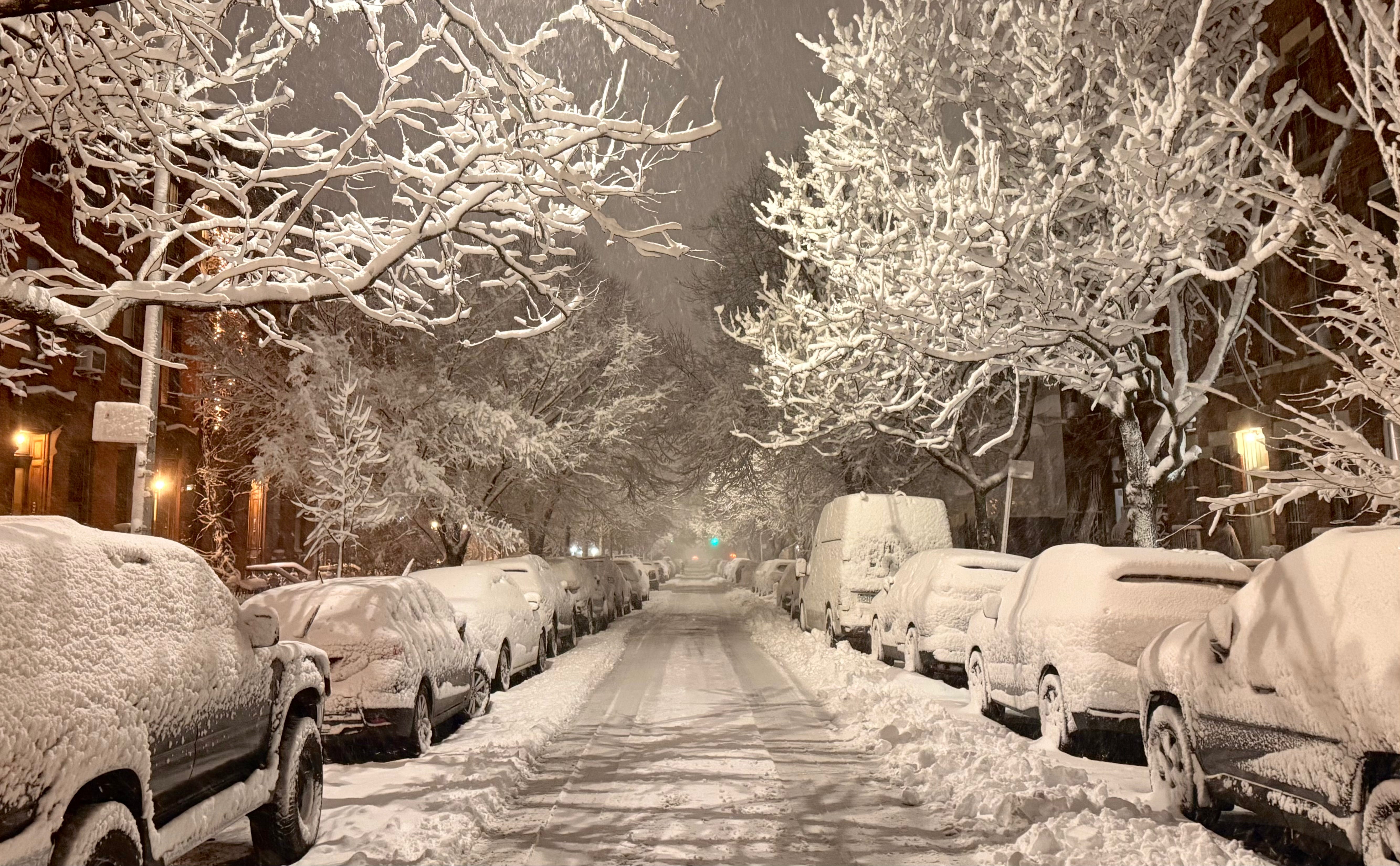
I love a snow storm in New York. Sometimes in a New York winter it will snow in a way that effectively shuts the city down. People will trudge to bodegas for cans of soup with plastic bags tied around their shoes. Sliding cars will be abandoned at weird angles. Dogs and small children will lose their minds. You’ll stand on a street corner in a wet, blinding wind, before a small ocean of slush already churned by the busses, make eye contact with the stranger next to you, and share a singular, pre-verbal moment: that look that says “yep- here we are.”
Weather like that can be a grand equalizer. A Bentley SUV isn’t getting much further up Flatbush Avenue than the dollar van. Doesn’t matter how expensive your shoes or your haircut are, they’re both gonna get wet. In a big ole snow storm, this great, galumphing city slows to a careful limp. There’s an evenness to the pulse, a peculiar, necessary, shared quiet. We’re all in it together.
I think this is a helpful metaphor for where we find ourselves in many creative industries today. While the democratization of technological tools has given people extraordinary new paths to realizing creativity, the resulting perfect storm of unlimited content and suddenly unreliable business models, combined with the looming specter of AI, has set a whole host of creative sectors adrift. Film and television are one of those that is thoroughly out-to-sea at the moment. Quite suddenly no longer answering to a mono-culture, and thrust into an attention-economy ruled by social media, TV and Film have found themselves extraordinarily devalued. This risky business to begin with, is barely able to rely upon a single equation it used to, and the panic and collateral damage of the storm continues to spread.
But for those of us who are still struggling to win notice from the traditional gatekeepers, this leveling might be a generational opportunity. Every panel on film distribution at every film festival I’ve attended in the past few years has basically had the same answer for how to put a film out into the world in this new reality: some version of a shrug and “get creative.” The people who have been doing this their whole lives don’t know how it works anymore, or how it might work tomorrow. Each left-field win is touted as the “future” of the business, and new startups and platforms to capitalize on them pop up like dandelions, then live and die in a day.
There’s a growing group of people that aren’t buying it. And by “it” I mean the “Film Business” itself, at least as a thing that deserves capital letters anymore. Ted Hope, producer and leading voice of the newly coined “NonDē” (non-dependent) film movement, refers to it as “FKA The Film Biz” (formerly known as…). This is more than cute commentary. It’s an attempt at normalizing the reality that the film industry of as recently as ten years ago, barely exists in a recognizable form anymore. The path forward, according to hope, is to shed even the “Independent Film” moniker— as Indie films still answer to outdated studio-system realities of distribution and support infrastructure— and to step into non-dependent, artist-led communities and fully artist-owned films and enterprises. If this sounds like your creative class (or just interesting), I heartily recommend Ted Hope’s Substack: Hope For Film. It’s a deep mine of resources and positivity in these wild times.
When I started reading Hope’s stuff, I had exactly that stranger-in-the-snow moment of recognition. Here we are. Here was someone who had spent a career inside the industry, who was not trying to deny that the sky was falling. Instead, he was pointing to where it all lay at our feet, energized by the things we might be able to build in its stead. Because if nobody knows how to make film and TV profitable anymore, then all bets are off. Suddenly we’ve got a wide open field with no footprints yet, a place to play and experiment, to do the things that artists, not executives, love to do. Perhaps this can allow us to put aside notions of what were are supposed to do, and the insidiousness of constant comparison. If we’re able to take away those constraints, the thing that remains is a much more basic unit of expression. Hopefully what we’re left with is a truly authentic gesture: uncluttered, personal, and deeply felt. The kind of art that is powerful through its connectivity as opposed to empty metrics of pure scale.
Buzz-wordy as they may be, connectivity, experimentation, and community-building are indeed the driving forces behind How to Build a Fire. And it’s clear that our film is a part of a much broader ecosystem of work that sees the turbulent weather as a potentially cleansing industry-reset. Maybe this storm can slow the business enough that the people within it, who have unwittingly fashioned themselves into cogs, can remember the human reasons behind making things again. Maybe small stories can come back to big screens. Maybe a little humility in the face of change can make us better listeners, more prayerful with, and protective of our own attention. I hope so.
-jamie
And, again, what an extraordinary writer you are, Jamie.
So interesting. An inside view of whats happening in the film industry. Feels open to more creative input, truly independent projects. and more hopeful. Thanks,